


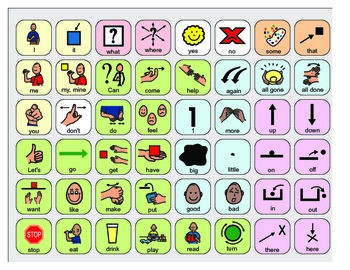
Artifact 7- Boardmaker/PECS/AAC

ISTE-S Creative Communicator 6.0
A student using any of these AAC technologies are using technology to express themselves. Students can also use a variety of these types of technologies to express themselves for many purposes and needs. By finding an effective way of communicating, students can also create their own educational goals and improve their own learning outcomes.
ISTE-E Designer 5.a
As an educator, I can use many of these technologies to customize my student's learning experience. I can use Boardmaker or PECS to create a personalized vocabulary for a student to use and even improve upon them as the student's knowledge grows. Allowing a student the opportunity to effectively communicate gives them the chance to learn independently and at their own speed.
INTASC Principle #4
I understand that I can use a variety of strategies to ensure student understanding. With that being said, I can implement AAC into my classroom to benefit certain students. Incorporating the AAC with all or some of my students can help them learn independently and develop different skills like creativity and critical thinking.
AAC stands for augmentative or alternative communication.
ASHA defines AAC as including all forms of communication (other than oral speech) that are used to express thoughts, needs, wants, and ideas(Subock, 2018).
The resource below provides ideas and strategies to including AAC in the classroom (Downey et al., 2004)
https://leader.pubs.asha.org/doi/full/10.1044/leader.FTR2.09172004.6
If you click on the image to the left, you will be able to view a comparison of Boardmaker, PECS and another AAC app that I found. This document compares the similarities of the three different technologies and offers insight to usability and which would be best suited for different types of people.
Below are resources for AAC in different curriculum areas like math(Zangari, 2013), Reading Comprehension(Erickson, 2003), and writing (Sturm, 2003):
https://praacticalaac.org/praactical/math-science-and-aac/
https://leader.pubs.asha.org/doi/10.1044/leader.FTR1.08122003.6
https://leader.pubs.asha.org/doi/10.1044/leader.FTR2.08162003.8
In the event of an emergency, every individual should be equipped with a plan for what is needed for them to be able to effectively communicate. After looking at some resources, I have determined that a go bag is very important (Helland, 2020). What is inside this go bag can vary depending on the individual. Some of the things I saw included were low tech options for AAC, multiple types of chargers for hi-tech AAC devices, a backup of insurance forms, and a flash drive including all of the vocabulary for that individuals AAC. I have provided a link below to give a quick overview of this type of information
https://aaccommunity.net/2018/09/emergency-preparation-for-aac/
LAMP- LAMP is an AAC app available on the iPad. In the app is a full english vocabulary. The vocabulary is divides up into different categories and some have folders with related words as well. You can use this vocabulary to create customized communication boards for anyone with language impairments. LAMP also has many different voices to chose from that will speak the words that are clicked on.
Proloquo2go- this app is also available on the iPad and is similar to LAMP. the vocabulary is color coded into different categories and also has folders of related words and different tenses. Proloquo2go can also create customized boards and has a text-to-speech option for words to be read aloud.
References:
Downey, D., Daugherty, P., Helt, S., & Daugherty, D. (2004). Integrating AAC Into the Classroom. The ASHA Leader, 9(17), 6–36. https://doi.org/10.1044/leader.ftr2.09172004.6
Erickson, K. (2003). Reading comprehension in AAC. The ASHA Leader, 8(12), [online]. https://doi.org/10. 1044/leader.FTR1.08122003.6
Helland, K. (2020, June). Emergency Preparation for AAC. Tech Owl at Institute on Disabilities at Temple University. https://aaccommunity.net/2018/09/emergency-preparation-for-aac/.
Sturm, J.M. (2003). Writing in AAC. The ASHA Leader, 8(16), [online]. https://doi.org/10.1044/leader.FTR2.08162003.8
Subock, M. (2018). The role of augmentative alternative communication systems for children with autism spectrum disorder [PowerPoint Slides]. Center for Autism and Related Disorders at Kennedy Krieger Institute. https://www.kennedykrieger.org/sites/default/files/library/documents/patient-care/centers-and-programs/center-for-autism-and-related-disorders/4-11-18-augumentative-alternative-communication-systems-children-autism-spectrum-disorder.pdf
Zangari, C. (2013, February 22). Math, science, and AAC. PrAACtical AAC. https://praacticalaac.org/praactical/math-science-and-aac/